Parking space detection is one of the foundations of a modern parking guidance system. Before a system can guide drivers toward available spaces, it needs reliable information about which spaces are occupied, which are vacant, and how that information should be communicated to drivers and operators.
For project owners, system integrators, and parking operators, choosing between camera-based and sensor-based detection is therefore more than a hardware decision. The choice affects installation, coverage, wiring, maintenance, data management, and how the system can adapt to the physical characteristics of the parking facility.
How Do Camera-Based and Sensor-Based Detection Work?
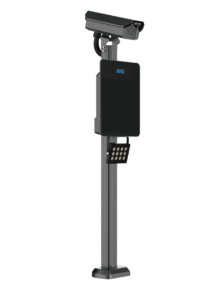
Camera-based parking detection uses cameras to observe parking areas and identify vehicle occupancy through image-based analysis. Instead of installing one detection device directly at every parking space, a camera can monitor a defined visual area, depending on the selected system architecture and site conditions.
Sensor-based detection takes a different approach. Individual parking spaces can be monitored through dedicated sensing technologies.
For example, our ultrasonic parking guidance sensor uses non-contact ultrasonic ranging to detect parking-space occupancy in indoor parking facilities. It supports parking status monitoring and can work with parking indicator lights to provide local guidance.
Other sensing technologies serve different environments. Our infrared parking guidance sensor is designed for indoor mechanical parking garages and multi-level parking equipment, while our NB-IoT parking sensor uses geomagnetic detection for outdoor and curbside parking applications.
Camera-Based Detection: Where Does It Make Sense?
Camera-based detection can be attractive when a project requires broader visual coverage or when the parking layout makes space-by-space sensor installation less convenient. It can also support projects where parking operators want detection data to become part of a wider visual management environment.
The actual suitability depends on factors such as mounting positions, ceiling structures, lighting, obstructions, lane geometry, and the required coverage area. These factors should be evaluated during a site survey rather than assuming that one camera configuration will work for every garage.
We have experience applying camera-based parking guidance to large facilities. At Shenzhen World Exhibition & Convention Center, we provided a parking solution incorporating camera parking guidance and LPR barrier gate systems.
We have also applied different detection technologies within the same major project. At Terminal 2 of Hong Kong International Airport, our camera parking guidance system is used for regular parking areas, while a traditional ultrasonic parking guidance system is used for tour-bus parking bays.
These projects illustrate an important point for B2B buyers: camera and sensor technologies do not necessarily have to compete with each other. Different parking areas within the same facility may require different detection approaches.
This illustrates an important point for B2B projects: camera and sensor technologies do not necessarily have to compete with each other. Different parking areas may require different detection approaches.
Sensor-Based Detection: When Is It the Better Option?
Dedicated sensors can provide a straightforward method for monitoring individual spaces, particularly when the parking structure and operating requirements are well defined.
Our ultrasonic parking guidance sensor, for example, uses ultrasonic ranging to monitor parking-space occupancy and supports RS485 communication. This makes it a practical option for indoor parking facilities where space-level occupancy detection and local parking guidance are required.
Sensor selection should also reflect the parking environment. Mechanical parking equipment may call for infrared detection, while outdoor curbside spaces may require a more environmentally robust technology such as geomagnetic detection. Our NB-IoT parking sensor is specified with IP68 protection, resistance to pressure up to 28 tons, and an operating temperature range of -40°C to +85°C.
What Should Project Buyers Compare?
For teams evaluating car park management system suppliers, the most useful comparison is not simply “camera versus sensor.” Instead, evaluate the complete operating environment.
Consider:
- Coverage: How many spaces need to be monitored, and how are they distributed?
- Installation: Are there suitable mounting points, cable routes, and maintenance access?
- Environment: Is the facility indoor, outdoor, mechanical, underground, or exposed to harsh conditions?
- Communication: What network or communication architecture does the project require?
- Maintenance: How easily can devices be inspected, replaced, configured, or upgraded?
- Integration: Can occupancy data connect with guidance displays, parking management software, access control, or other systems?
- Scalability: Can the selected architecture support future changes in parking capacity or operating requirements?
These considerations are especially important when evaluating advanced parking management systems. A technically sophisticated product is not automatically the right product if its installation requirements do not match the site.
Why Should Detection Technology Be Selected by Application?
There is no universal detection method that should be applied to every parking facility. A large commercial garage, mechanical parking structure, airport, roadside parking area, and mixed-use development can have very different requirements.
Our approach is to assess the parking environment and operating objectives first, then match the appropriate detection, guidance, access-control, and management technologies to the project. Our portfolio covers parking guidance as well as LPR and barrier systems, curbside management, identity and access authentication, pedestrian turnstiles, and RFID access control.
For customers comparing solutions from car park management system suppliers, this application-based approach can make the procurement process more practical. Rather than selecting equipment based only on individual specifications, project teams can evaluate the complete relationship between detection, guidance, communication, management, and site conditions.
At AKE Parking, we have developed both camera-based and sensor-based parking guidance experience because real-world parking projects rarely have identical requirements. The objective is not to choose the most complicated technology, but to build a detection architecture that provides dependable occupancy information and fits the facility’s physical and operational conditions.