Airport parking demands a different operational model from ordinary commercial parking. Passenger drop-offs, staff vehicles, rental cars, taxis, private cars, and other traffic can converge around entrances and parking facilities at the same time. During peak travel periods, even a small delay at an entry or exit can create queues that affect the wider road network.
At AKE Parking, we believe an effective vehicle parking management system should manage the complete vehicle journey rather than simply open and close a barrier. By combining vehicle identification, access control, barrier management, parking guidance, and centralized software, we help airports and transport hubs handle high-volume traffic with greater speed and operational control.
Why Does Airport Traffic Require a Vehicle Parking Management System?
An airport requires a parking system that can respond to changing traffic volumes, different vehicle categories, and multiple operating zones.
Unlike a typical parking facility, an airport may have short-term parking, long-term parking, employee parking, passenger pickup areas, and other controlled zones. Access rules and traffic patterns vary across areas.
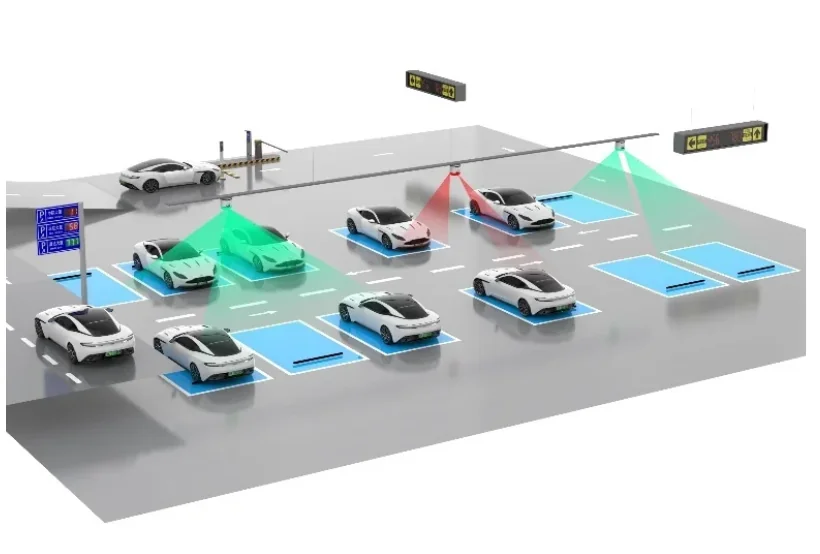
Our vehicle parking management system approach is based on coordinating multiple functions. Vehicle identification can determine who or what is approaching, access rules can determine whether entry is permitted, and barrier equipment can control the physical movement of vehicles. Parking guidance can then help drivers find available spaces and reduce unnecessary circulation.
This integrated approach is particularly important when traffic volume rises quickly during flight arrival and departure peaks.
How Does LPR Technology Help Airports Process Vehicles Faster?
License plate recognition helps airports automate vehicle identification and reduce dependence on manual checks.
Our LPR and barrier systems are designed for AI-powered vehicle access control, combining vehicle recognition with reliable barrier management. This allows the entrance process to be coordinated around vehicle identification and authorization instead of requiring every driver to stop for manual verification.
For airport operators, automation can make access more consistent. Authorized vehicles can follow predefined rules, while exceptions can be handled through the appropriate management workflow.
The benefit is not simply faster gate operation. It is a more structured process in which identification, authorization, and barrier control work together.
How Can Parking Guidance Reduce Airport Parking Congestion?
Parking guidance reduces congestion by helping drivers locate available spaces instead of searching through multiple parking areas.
We provide parking guidance systems that monitor parking availability and communicate useful information to drivers through guidance displays. Our ultrasonic parking guidance sensor, for example, supports parking-space status monitoring, parking-time recording, and local data storage. We use ultrasonic detection, RS485 communication, and support a DC 12V–30V operating voltage with power consumption of ≤2W.
For airport projects, the important principle is information flow. Sensors collect parking-status information, the system processes that information, and displays can guide drivers toward available areas.
This can help reduce unnecessary vehicle circulation inside a parking facility, which is especially valuable when demand is high.
What Should Car Park Management System Suppliers Consider for Airports?
Experienced car park management system suppliers should evaluate the airport as a complete traffic environment rather than supplying isolated parking equipment.
Before selecting hardware, project teams should consider the number and location of entrances and exits, traffic peaks, parking categories, network requirements, guidance routes, access permissions, and integration with existing systems.
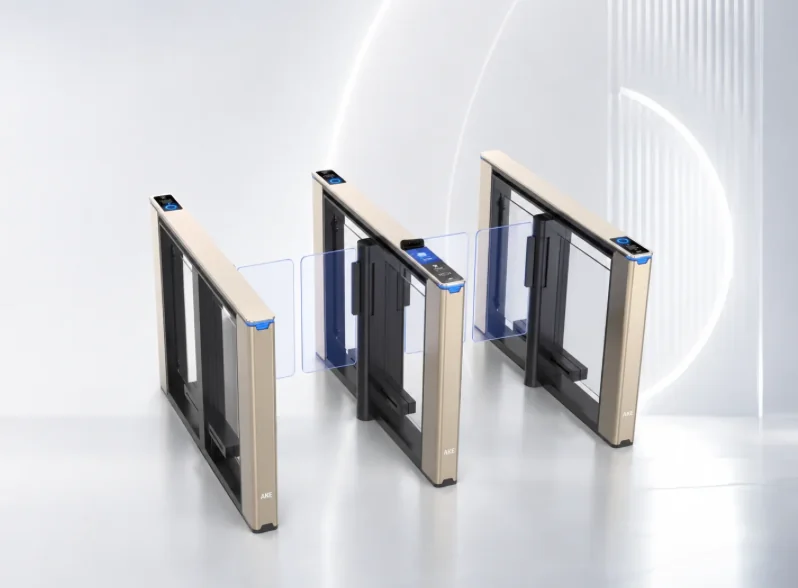
We follow a consultation and solution-design process in which project requirements and site conditions are considered before the final system configuration. Our current solution portfolio includes LPR and barrier systems, parking guidance, curbside management, identity and access authentication, pedestrian turnstiles, and RFID access control.
This approach allows airport operators and system integrators to select technologies according to actual operational requirements rather than simply purchasing a standard equipment package.
How Can AKE Parking Support High-Volume Airport Operations?
At AKE Parking, we combine smart hardware, software, and project support to respond to high-volume parking and access requirements.
Our airport and transport-hub solutions are specifically positioned to handle high-volume traffic with speed and precision. We also have real-world airport experience: our company history records that we won the intelligent parking transformation project of Guangzhou Baiyun International Airport in 2017, while our current global case portfolio includes Hong Kong International Airport.
For international B2B customers, we also support OEM/ODM cooperation and project-based solution design. Our current website describes consultation, customized solution design, production and delivery, and deployment support as parts of our project workflow.
This is important for airport projects because every site has different layouts, traffic rules, existing infrastructure, and integration requirements.
How Can an Airport Build a More Efficient Parking Workflow?
An airport can improve parking efficiency by connecting vehicle identification, access control, barrier operation, parking guidance, and operational data into one coordinated workflow.
The objective is not simply to make individual devices operate faster. Instead, the entire journey should be considered: identify the vehicle at the entrance, authorize access, control the barrier, guide the driver toward an appropriate parking area, monitor parking availability, and manage the exit process.
As car park management system suppliers, we focus on this system-level approach because airport traffic is too complex to manage effectively through disconnected equipment.
At AKE Parking, we provide scalable parking infrastructure for customers, be they airport operators, parking operators, system integrators, or project developers, supporting operational efficiency and a smoother driver experience. By combining intelligent access technologies with parking guidance and centralized management, a vehicle parking management system can become an important part of modern airport traffic management.