When planning a modern parking facility, project owners and system integrators typically encounter two terms: parking guidance and parking management. Though closely related, they target different needs. Understanding the difference helps developers, operators, and car park management system suppliers select the right system architecture for a project.
At AKE Parking, we provide smart parking and access solutions designed to connect vehicle access, parking guidance, management, and operational data. Our goal is not simply to install individual devices, but to help customers build a more efficient and manageable parking environment.
What Is a Parking Guidance System?
A parking guidance system primarily helps drivers find available parking spaces and navigate through a facility more efficiently. Its core function is to collect parking-space information and present useful directions to drivers in real time.
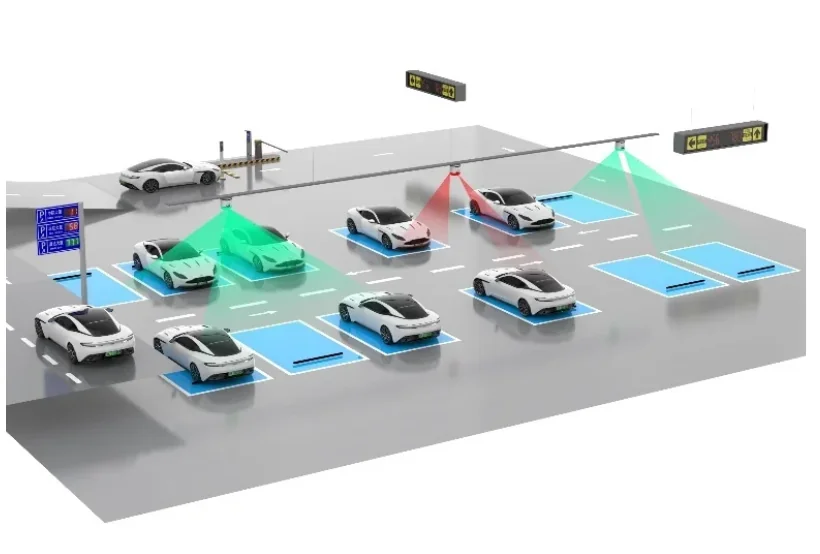
For example, indoor parking guidance can use space-detection technologies to determine whether individual spaces are occupied. The resulting information can be displayed through entrance signs, directional displays, floor indicators, or other guidance equipment. Drivers can therefore identify available areas without repeatedly circulating through the garage.
For outdoor applications, AKE also provides geomagnetic parking guidance technology. Its geomagnetic detectors identify changes in the magnetic field caused by vehicles occupying parking spaces and transmit detection information wirelessly to controllers.
Parking guidance is well suited to shopping malls, office buildings, transportation hubs, and other large parking facilities where drivers need clear, real-time information to locate available spaces and reduce unnecessary circulation.
What Does a Parking Management System Do?
A parking management system takes a broader operational role. Instead of focusing mainly on where drivers can park, it manages vehicle entry and exit, payment, parking records, operational data, and system status.
For example, AKE’s parking management solution can integrate license plate recognition cameras, barrier gates, controllers, parking management software, and payment functions. Vehicle license plates can be automatically recognized at entrances and exits, while the management platform can support traffic-volume analysis, payment analysis, equipment monitoring, customer classification, and financial management.
For property owners and operators, this distinction is important. A guidance system helps improve the driver’s parking journey, while a management system provides tools for controlling and analyzing the operation of the entire facility.
How Are Parking Guidance and Parking Management Connected?
Parking guidance and parking management should not necessarily be treated as competing technologies. In a well-designed project, they can work together as different layers of one parking ecosystem.
The guidance layer collects or receives information about parking-space availability and communicates it to drivers. The management layer handles access, operational rules, transactions, equipment status, and business data. When these systems are integrated, operators can gain a more complete view of parking activity.
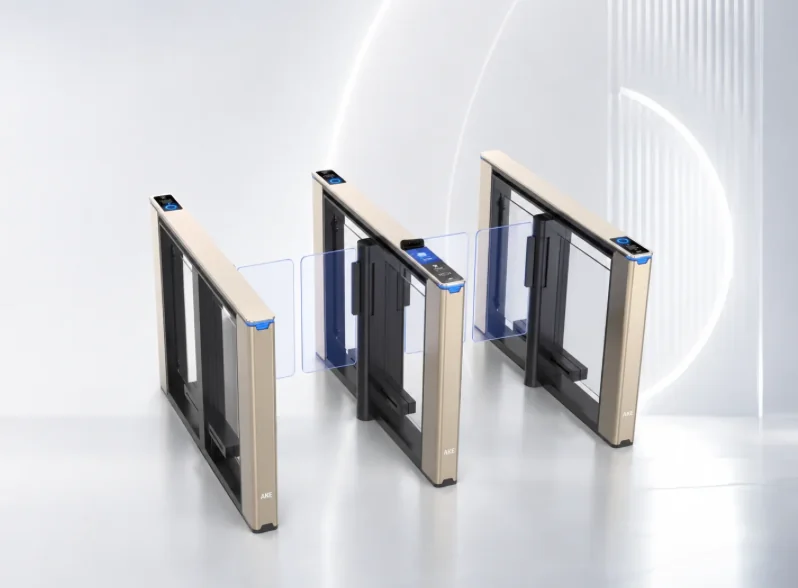
AKE’s parking solutions are designed around this integrated approach. Our solutions cover parking guidance, parking management, LPR and barrier systems, access authentication, pedestrian turnstiles, and RFID access control.
This integration can be particularly useful for large commercial complexes, airports, offices, residential communities, industrial parks, and smart-city projects.
What Should B2B Buyers Consider When Choosing a Parking System?
For B2B buyers, selecting technology should begin with operational requirements rather than individual hardware specifications.
First, consider site scale and traffic volume. A small office garage may require a simpler configuration, while a shopping mall or transportation hub may need coordinated access control, guidance, payment, and centralized monitoring.
Second, consider management requirements. If the project needs vehicle classification, payment management, equipment monitoring, operational statistics, or centralized control, a parking management system becomes more important.
Third, evaluate integration capability. Many parking facilities already have CCTV, payment equipment, access control, or other connected systems in place. The parking management system should be able to communicate with these existing systems and share relevant data, rather than operating as an isolated subsystem.
Finally, consider deployment and long-term support. System documentation, installation guidance, software support, maintenance, and customization can directly affect the total project experience.
Why Choose AKE Parking for Integrated Parking Solutions?
Drawing on years of experience in smart parking, we focus on helping project partners address practical parking and access challenges. Our current solution portfolio includes parking guidance, LPR and barrier systems, curbside management, identity and access authentication, pedestrian turnstiles, and RFID access control.
We also support OEM/ODM projects, customized software interfaces, hardware adaptations, technical documentation, remote setup guidance, and ongoing technical support. These capabilities are valuable for international integrators, distributors, developers, and project contractors that need more than individual parking devices.
As AKE Parking, we believe the right solution should connect driver experience with operational efficiency. Parking guidance can make it easier to locate available spaces, while parking management can help operators control access, payments, equipment, and business information. Together, they create a more complete foundation for smart parking operations.
For project owners and car park management system suppliers, understanding this distinction is the first step toward designing a system that matches real operational needs rather than simply adding more equipment.